
Barrier-Free Fire Alarm Installation in Ontario: Making Safety Accessible for Everyone
Creating buildings that are safe, accessible, and inclusive is more than an ideal—it’s a code requirement. At Certi-Fire, we take pride in helping electrical contractors, property owners and designers meet Ontario’s barrier-free design standards, as defined in Section 3.8 of the Ontario Building Code (OBC).
These requirements ensure that fire alarm systems—and specifically manual pull stations—are accessible to every person, regardless of ability.
Understanding Barrier-Free Design
Barrier-free design is built around one simple principle: access for all.
The National Building Code of Canada (NBC), as adopted and is amended by the Ontario Amendments to the National Building Code of Canada, defines minimum dimensions to ensure people using mobility aids can safely navigate buildings.
Key accessibility standards include:
A clear floor space of 800 mm by 1,350 mm
A clear width of 1,000 mm for a 90° turn
A 2,100 mm turning diameter for a 180° turn in one motion
A 1,700 mm diameter for a 180° turn in multiple motions
These specifications ensure ease of movement for wheelchairs, canes, walkers, or service animals.
When Barrier-Free Design Applies
Under OBC Article 3.8.1.1, barrier-free design applies to most occupied building types—with some exceptions, such as:
Detached and semi-detached houses with fewer than eight residents
High-hazard industrial occupancies (Group F, Division 1)
Buildings not occupied daily (e.g., pump houses, telephone exchanges)
Temporary worker accommodations
This ensures that public buildings, workplaces, and most residential buildings remain accessible for day-to-day use and for emergencies.
Fire Alarm Pull Station Placement RequirementsFire alarm pull stations are essential in any emergency, and their placement must meet both safety and accessibility standards.
Under OBC 3.8.1.5 – Controls, manual pull stations must:
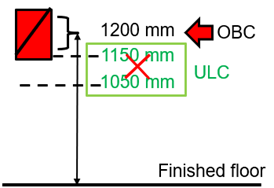
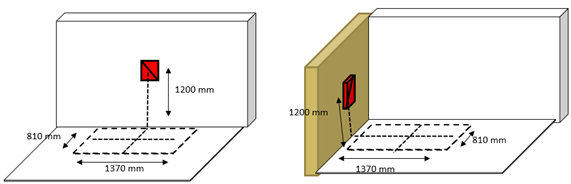
Be mounted 1,200 mm above the finished floor.
Be positioned next to a clear floor space of 810 mm by 1,370 mm centred on the control and manual pull station.
Be operable
(i) using one hand, without requiring tight grasping, pinching with fingers or twisting of the wrist, and with a force of not more than 22.2 N, in the case of a manual station, and
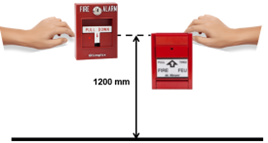
(ii) using a closed fist, and with a force of not more than 22.2 N, in the case of all other controls.
Require no more than 22.2 N of force and allow use of one hand without grasping or twisting.
This ensures that the control can be reached and used by individuals with limited mobility or strength.
Under 1.5.1.2(1) of Ontario Amendments, these OBC requirements override referenced documents like ULC S524 in case of conflict—meaning accessibility takes precedence.
How Certi-Fire Keeps You Code-Compliant
Certi‑Fire teaches with purpose: ensuring understanding, accessibility, and life safety for all.
Our technicians and Qualified Fire Alarm Electricians ensure that every system we install or inspect meets Ontario’s barrier-free standards, from placement to performance.
We help architects, engineers, and building owners interpret the intersection between accessibility and life safety codes, ensuring safety systems genuinely serve everyone.
Key benefits of partnering with Certi-Fire include:
Expertise in OBC Section 3.8 compliance
Accessible manual pull station design and placement
Education for contractors and owners on code interpretation and updates